Comparing Shark IQ/AI robots with iRobot Roomba. We focus on app complexity, maintenance, and real-world reliability for older adults.
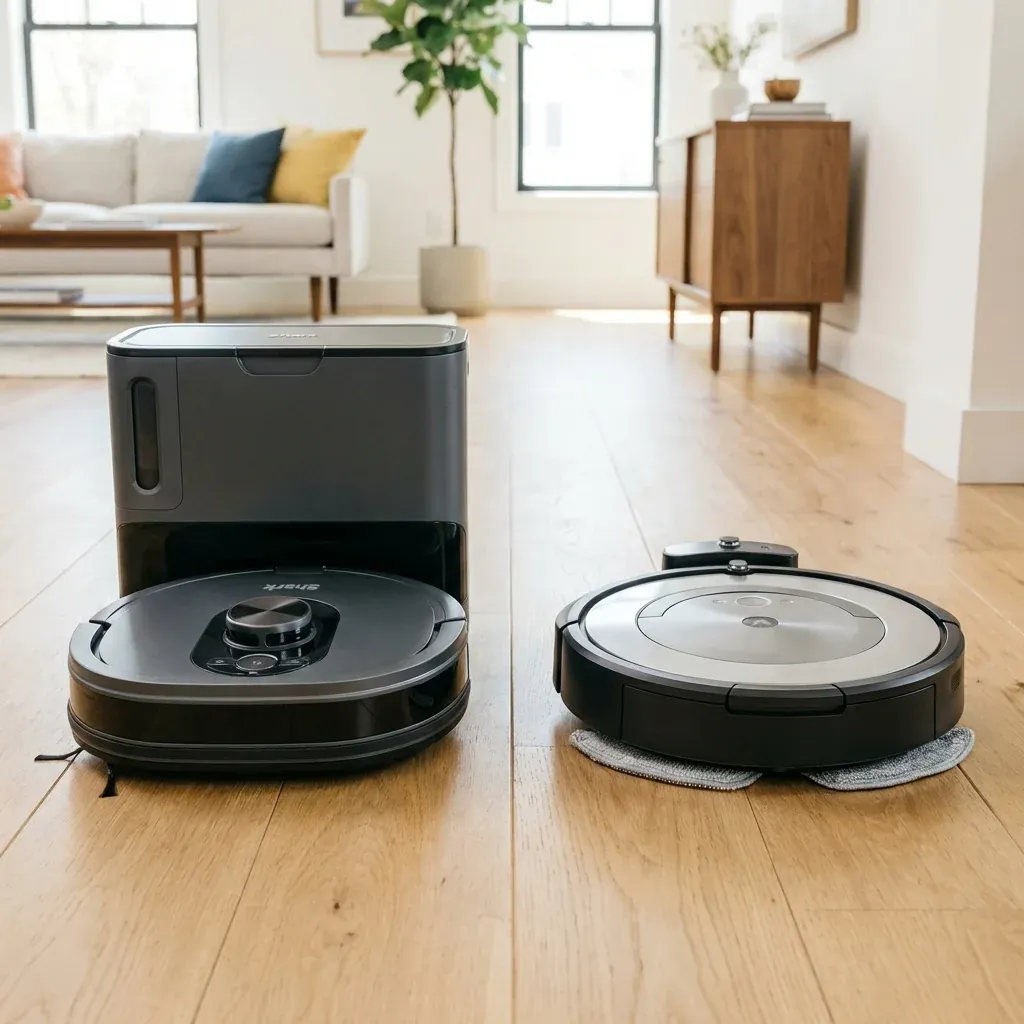
Robot vacuums promise hands-free cleaning, but they are only useful if you can actually set them up and maintain them. For seniors, the key factors are not just cleaning power but also app simplicity, ease of emptying, and reliability.
Comparing Shark IQ/AI robots with iRobot Roomba. We focus on app complexity, maintenance, and real-world reliability for older adults.
- Symptoms: Deciding between Shark and iRobot brands, Want a robot that is easy to set up, Looking for low-maintenance robot vacuum
- Tools: none
- Difficulty: Easy
How do Shark and Roomba compare on these real-world metrics?
1. App Setup Complexity
Both brands require a smartphone app to unlock full features like scheduling and room mapping.
- iRobot App (for Roomba): Very polished with detailed tutorials. However, it has many advanced features that can be overwhelming (e.g., “Genius” AI suggestions, “Cleaning Preferences” sliders).
- SharkClean App (for IQ/AI): Simpler interface with fewer options. This is actually a plus for seniors who just want to press “Clean” and walk away.
The Verdict: For pure simplicity, the Shark app wins. For users who want granular control, Roomba is better.
2. Self-Empty Base
Both Shark and Roomba offer self-empty bases that automatically suck dirt out of the robot into a larger bag or bin.
- Shark Self-Empty Base: Uses a bagless bin (on older models) or disposable bags. The bagless version requires you to manually dump the bin every 30 days.
- Roomba Clean Base: Uses disposable bags only. Bags are expensive (~$10 each) but very hygienic.
The Verdict: If you hate touching dust, the Roomba bagged system is cleaner. If you want lower long-term costs, Shark’s bagless option saves money.
3. Hair Wrap & Brush Maintenance
This is where Shark has a significant advantage.
- Shark IQ (with Self-Cleaning Brushroll): The brush roll has a built-in comb that actively pulls hair off the bristles during operation. You almost never need to manually clean it.
- Roomba (most models): Hair wraps around the rollers and requires manual cutting with scissors every 2-4 weeks.
The Verdict: Shark’s self-cleaning brushroll is a game-changer for pet owners and anyone who doesn’t want to bend down and maintain the robot.
4. Navigation & Reliability
Modern robots from both brands use LIDAR or camera-based navigation to build maps of your home.
- Shark AI (Matrix series): Uses a camera for object avoidance. It can sometimes get “confused” by dark carpets.
- Roomba j7+: Uses a camera with “PrecisionVision” to identify and avoid pet waste and cables. This is a premium feature not found on Shark.
The Verdict: If you have pets that have “accidents,” the Roomba j7+ is the safer choice. For general homes, both navigate equally well.
Head-to-Head Comparison Table
| Feature | Shark IQ/AI Robot | iRobot Roomba i3/j7 |
|---|---|---|
| App Simplicity | Simpler | More Features |
| Self-Empty Cost | Lower (Bagless Option) | Higher (Bags Only) |
| Hair Wrap | Self-Cleaning Brush | Manual Cleaning Required |
| Object Avoidance | Basic | Advanced (j7+ only) |
| Typical Price | $300 - $500 | $350 - $700 |
Our Recommendation for Seniors
- Choose Shark IQ Robot if: You want a “set it and forget it” experience with minimal maintenance. The self-cleaning brushroll alone is worth the price.
- Choose Roomba j7+ if: You have unpredictable pets and need the robot to intelligently avoid obstacles. The premium price reflects premium peace of mind.
TIP: Whichever robot you choose, make sure your Wi-Fi router broadcasts a dedicated 2.4GHz network. Most robot vacuums cannot connect to 5GHz, which is a common cause of setup failures.